

Let Jian Jie is a Valuation Actuary at PartnerRe. He is a Fellow (FIA) of the Institute and Faculty of Actuaries and holds a Bachelor of Business in Actuarial Science and Accountancy from NTU.
Behind the scenes of some of the world’s biggest financial decisions and future planning lies the often-unseen work of actuaries. These mathematical experts analyse risks and uncertainties to help organisations — from insurance firms to governments — make informed, strategic choices.
Let Jian Jie and Yong Ziling exemplify this expertise. Jian Jie, a Valuation Actuary at PartnerRe, ensures the company is able to meet its future obligations by valuing liabilities and analysing profits and losses. Ziling, an Actuarial Partner at EY, delivers tailored solutions to clients, provides expert guidance to her team, and plays a key role in identifying growth opportunities for her firm.
Both are Fellows of the Institute and Faculty of Actuaries (IFoA), the United Kingdom’s sole chartered professional body dedicated to educating, developing, and regulating actuaries worldwide. Fellowship is the IFoA’s highest qualification, and its recipients are highly regarded experts in their fields.
Former President and Fellow of the IFoA, Kartina Tahir Thomson, has 25 years of experience in Non-Life actuarial work, including reserving, pricing, capital, and Enterprise Risk Management. She has actively contributed to the profession, serving as IFoA President from 2024 to 2025 and holding key roles with the IFoA Foundation, Actuarial Association of Europe, and International Actuarial Association.
We spoke with Jian Jie, Ziling, and Kartina to hear about their experiences and insights into the actuarial profession.
Jian Jie, what first drew you to actuarial science?
Mathematics has always been my favourite subject since I was young. When I was deciding what to study at university, I attended an Actuarial Science career fair and received a pamphlet that said, “Love Maths? Consider a career in actuarial science.” At the fair, I learned that actuarial science involves applying mathematical and statistical methods to solve problems faced by insurance companies. The satisfaction of solving math problems, combined with the opportunity to tackle challenges in the financial industry, motivated me to pursue Actuarial Science in university.

Yong Ziling is an Actuarial Partner at EY. She is a Fellow (FIA) of the Institute and Faculty of Actuaries and holds a Bachelor of Business (Hons) in Actuarial Science and IT from NTU.
Ziling, can you tell us more about the actuarial science programme you pursued at NTU? How did it prepare you for your work today?
The business programme is thoughtfully structured to provide both breadth and depth. In the first year, students are introduced to a range of accounting and business modules, offering a solid foundation in key corporate concepts. From the second year onwards, the curriculum shifts to six specialized tracks. There is flexibility for students to pursue a double specialisation or select from a variety of elective courses to broaden their expertise.
Beyond technical knowledge, the programme includes non-academic modules such as strategic management, communication, and project-based learning. These components are designed to help students develop essential soft skills that are highly valued in the professional world.
Kartina, how would you explain what an actuary does to students who are new to the profession?
At the IFoA, we describe actuaries as problem solvers and strategic thinkers who use their mathematical skills to help measure the probability and risk of future events. They use these skills to predict the financial impact of these events on businesses and their clients. Increasingly, businesses and governments rely on actuaries to help them model and plan for the future.
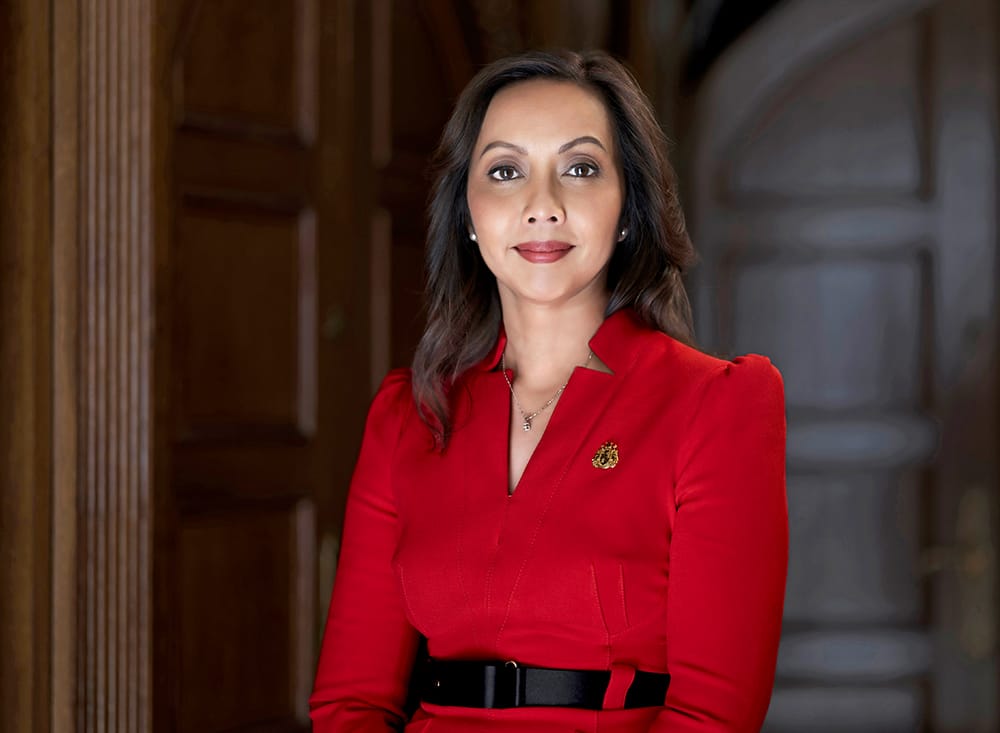
Kartina Tahir Thomson is the former President (2024–2025) of the Institute and Faculty of Actuaries.
Ziling, can you share your journey to becoming an IFoA Fellow?
There was an exemption arrangement between NTU and the IFoA, which made it a natural path for me to pursue. I also spent a couple of years working in the United States (US) from 2016 to 2018 and took a few modules under the Society of Actuaries (SOA). While both qualifications are valuable, I found that the IFoA curriculum aligned more closely with the needs and practices in the Asia-Pacific region.
It definitely wasn’t an easy journey — getting through the exams required strong time management, discipline, commitment, and a lot of resilience. For me, it took about seven years in total, during which I skipped a few exam sittings due to major life events like getting married and relocating to the US.
Jian Jie, what kinds of support or professional growth have you gained through your fellowship with the IFoA?
IFoA provides numerous opportunities for networking and professional growth. When I attended the qualification ceremony in London, I had a pleasant experience networking with other actuarial professionals and learning from their experiences across different markets. The IFoA also provides Professional Skills Training resources that offer practical knowledge and guidance on navigating situations we may encounter at work.
Which parts of your work do you find most fulfilling?
Jian Jie: The initial years of actuarial work are bound to involve many calculations and developing an understanding of them. As actuaries gain familiarity and proficiency, they may also have opportunities to explain these findings to stakeholders for business decision-making. I find this particularly enjoyable — much like solving a math problem back in school and explaining the solution to a peer.
Ziling: I find it rewarding to be a trusted advisor whom clients turn to when facing challenges — not necessarily because I have all the answers, but because they know I will work alongside them to find the right solutions. I also enjoy being a role model for the team by creating a collaborative and supportive environment and helping to nurture and develop the next generation of actuaries.
What opportunities or pathways can one explore in the actuarial profession?
Ziling: There are multiple paths within the insurance industry, such as life, general, reinsurance, and consulting. Within a company, actuaries can also take on diverse roles or specialise in various areas including distribution, pricing, valuation and risk management.
Beyond the insurance sector, the core skills actuaries develop, especially logical and analytical thinking, are highly transferable and can be applied to solving complex business problems across many industries.
Kartina: Traditionally, actuaries worked in pensions, insurance, and investments. Today, they’re also using data science and artificial intelligence to address challenges like climate change, cyber risk, and health. Actuaries use their core skills of problem solving and creative thinking to drive solutions.
What excites me most about the future is seeing actuaries apply their expertise to emerging fields like sustainability, global health and fintech. It’s inspiring to see our profession expanding into new arenas where we can address global challenges and make a real difference!
What advice would you offer students considering an actuarial career, Kartina?
If you love solving problems and thinking of creative solutions, and want a rewarding career where you can make a difference, the actuarial profession could be for you. As an actuary, you’ll apply your valued mathematical skills and creative thinking in a diverse and challenging field.
Your hard work will be rewarded with a competitive salary and transferable skills. As a member of the IFoA, you join a global profession with internationally recognised qualifications that enable you to work worldwide.