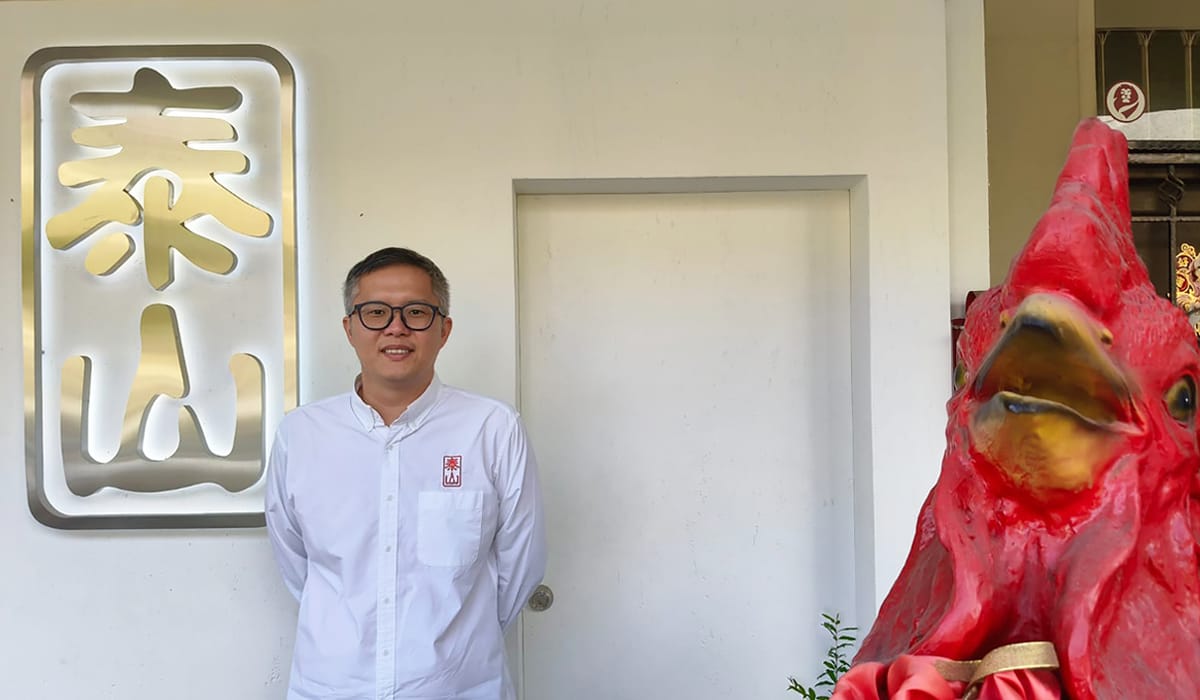
Kenny Toh is the Chief Strategic Officer at Toh Thye San Farm. He holds a Bachelor in Business Management from the University of Newcastle and a Bachelor in Business, majoring in International Business, from Berufsakademie.
For many Singaporeans, poultry is simply something that appears neatly packaged on a supermarket shelf or arrives on a restaurant plate. Behind that everyday convenience, however, is a complex industry spanning farming, processing, sourcing, food safety and cold-chain logistics.
For Kenny Toh, Chief Strategic Officer of Toh Thye San Farm and a fourth-generation member of the family business, that complexity is precisely what makes the agri-food industry interesting.
Kenny’s experience in the food industry was built from the ground up at Toh Thye San Farm, where he worked across operations, sourcing and product quality. Along the way, he developed a deeper understanding of the business and a strong interest in responsible farming and premium poultry production.
“I was drawn to the company’s commitment to quality, its focus on sustainable practices, and its reputation as a trusted local producer,” he said. “Joining Toh Thye San Farm allowed me to contribute meaningfully to an organisation that values both tradition and forward-looking growth.”
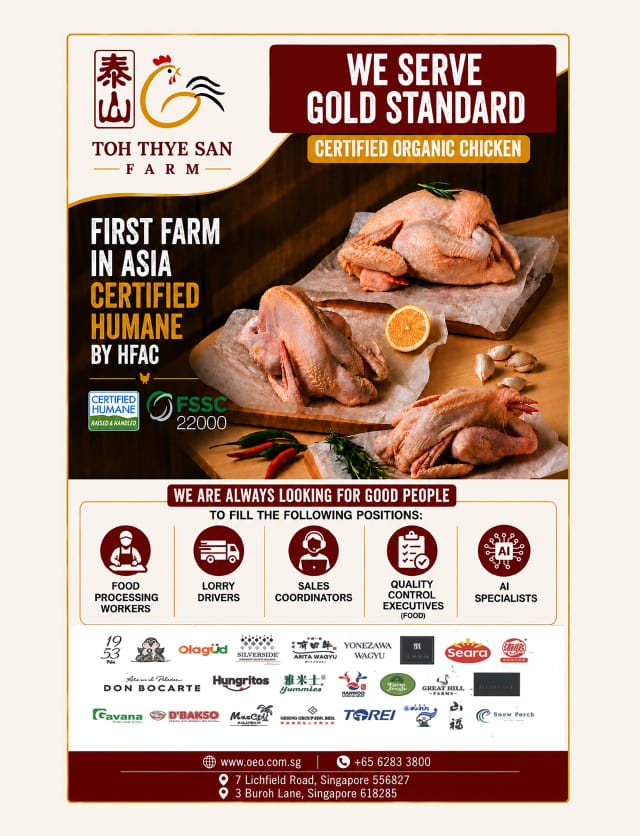
Today, Toh Thye San Farm has grown well beyond its kampong beginnings. It produces and supplies fresh chicken, duck and quail, alongside frozen and chilled products, to supermarkets, restaurants and foodservice partners across Singapore. Its operations span farming, processing, distribution and product innovation, supported by modern processing systems, strict food safety controls and a reliable cold chain.
But for Kenny, keeping the business moving forward is not simply about adopting the latest technology. It is about bringing together perspectives from different parts of the business and industry.
“A typical day involves meeting various people from different fields, so that we can amalgamate different movements from different fields to decide what is best for the company,” he explained.
Alongside his position at Toh Thye San Farm, Kenny is President of the Meat Traders Association of Singapore, where he balances business viability with the responsibilities of representing the wider industry.
“The biggest challenge that I have is to ensure business viability while at the same time handling my role as the President of the Meat Traders Association of Singapore to ensure that there is no conflict of interest.”
Farming Meets AI
The agri-food industry looks very different from the one Kenny first encountered. Technology now influences everything from production and processing to business decisions, and Toh Thye San Farm is looking to make AI part of that transformation.
“We now try to integrate AI in many of our day-to-day operations,” he shared.
The company is also building what he describes as a “mothership” for AI adoption, with the aim of connecting different strategic business units rather than having AI operate in isolated pockets. The goal is to make decision-making more holistic by bringing different parts of the organisation into the conversation.
That focus on resilience extends beyond technology. Toh Thye San Farm played a role in the first shipment of Indonesian live poultry to Singapore, helping diversify the country’s supply of live poultry beyond its longstanding reliance on Malaysia.
Kenny describes the experience as “particularly bittersweet”. While diversifying Singapore’s poultry supply was important for the industry, he had also invested extensively in Malaysia and was part of the existing supply chain.
“But we know that if there is no supply chain resiliency, we cannot survive,” he acknowledged.
Keeping the Roots, Changing the Rules
As a fourth-generation family business, Toh Thye San Farm faces a challenge familiar to many long-standing companies: how do you preserve what made the business successful without becoming stuck in the past?
For Kenny, he sees that heritage as a foundation rather than a constraint. The values established by earlier generations — quality, integrity and responsibility — continue to guide the business. At the same time, the company invests in modern farming systems, food safety technology, stronger cold-chain capabilities and product innovation.
But there is another part of the family-business culture that Kenny is determined to preserve. He describes it in Chinese as a concept that roughly translates to the “human touch”.
“We do want to keep that 人情味 alive. This is what makes us different from the rest,” he emphasised. “We want to keep the basis of family business around, but at the same time, be as modern as possible so that we are able to progress.”
And while the company values its family heritage, Kenny is clear that this does not mean giving family members an automatic advantage.
“Contrary to many family businesses, we reject nepotism and support meritocracy.”
That philosophy extends to the people the company hires, with merit taking precedence over family ties or conventional credentials.
Beyond What the Textbook Teaches
Kenny believes the industry has plenty to offer those who bring the right mindset.
“Today we are looking at more soft skills rather than what the textbook teaches,” he highlighted. In particular, he looks for innovation, the ability to work collectively and the ability to analyse critically.
It is an approach that reflects the changing nature of the business. Employees are no longer confined to traditional farming roles. They may find themselves navigating technology, supply chains, operations, food safety, product development or strategic decision-making.
For young professionals and technicians, that means plenty of opportunities to learn and cross-learn across different functions to gain hands-on experience.
“A career at Toh Thye San Farm offers hands-on learning, real responsibility, and the chance to contribute to Singapore’s growing agri-food sector,” Kenny said.
His advice to those considering the industry is straightforward: stay curious, be adaptable, and embrace both tradition and innovation.
“This industry rewards people who are willing to learn, solve problems, and work closely with teams across farming, processing, and operations.”
Securing More Than Supply
Looking ahead, Toh Thye San Farm aims to contribute by strengthening its premium poultry supply, investing in modern processing and cold-chain capabilities, and developing new products.
But for Kenny, the company’s role goes beyond what’s on the shelf.
“We aim to support Singapore’s long-term food security goals while continuing to deliver fresh, safe, and reliable poultry to the market.”
It’s the same balance Kenny is chasing across the business — modern systems and AI on one side, the human touch on the other. For a family business helping reshape Singapore’s supply chain, resilience and humanity are not contradictions. They are the strategy.